A 65-year-old male presents with abdominal pain, vomiting, and a history of multiple episodes of cholecystitis. X ray image is given below.
What is the most likely diagnosis?
A. Acute cholecystitis B. Gallstone ileus C. Small bowel volvulus D. Duodenal perforation
Answer:B. Gallstone ileus
Explanation: Rigler's Triad consists of pneumobilia, small bowel obstruction, and an ectopic gallstone, which is diagnostic of gallstone ileus. This condition occurs when a gallstone enters the bowel through a biliary-enteric fistula, leading to mechanical obstruction.
A large gallstone (>2.5 cm) erodes through the gallbladder wall, creating a cholecysto-enteric fistula (most commonly into the duodenum).
The stone enters the bowel and may cause obstruction, most often at the ileocecal valve due to its narrow lumen.
The presence of air in the biliary tree (pneumobilia) results from communication between the biliary and intestinal tracts.
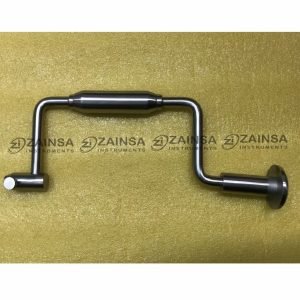
The Hudson brace is a manually operated surgical drill used in neurosurgery and orthopedic procedures. It consists of a hand-cranked mechanism with interchangeable drill bits for trephination or skull perforation.
Q ) A 68-year-old male with severe mitral regurgitation due to a prolapsed mitral valve is being evaluated for a MitraClip® procedure. Which of the following is a known limitation of the MitraClip® treatment?
A) It has a high risk of causing permanent heart valve failure.
B) Long-term durability of the device is uncertain, and its effectiveness may decline over time.
C) The MitraClip® is associated with increased risk of severe aortic stenosis.
D) The procedure is recommended for all patients with moderate to severe mitral regurgitation, regardless of surgical risk.
Q) The sensitivity and specificity of sestamibi for parathyroid localization are reported to be 79% and 90%, respectively. Which of the following best describes a potential source of false positives in sestamibi imaging?
A) Parathyroid adenomas in patients with hyperparathyroidism
B) Thyroid nodules with high oxyphilic content, such as Hürthle cell nodules
Q: Which of the following statements is most accurate regarding axillary lymph node dissection (ALND) in breast cancer staging?
a) Level I and level II ALND requires the removal of at least 10 lymph nodes for accurate staging, and level III nodes should always be included in the dissection, regardless of the presence of gross disease in levels I and II.
b) The axillary dissection should include tissue from levels I and II, with a focus on the area inferior to the axillary vein, extending laterally to the latissimus dorsi muscle and medially to the pectoralis minor muscle, when there is no gross disease in level II nodes.
c) Level III nodes should be dissected in all cases of breast cancer for accurate staging, as they are always involved in metastatic spread.
d) Level I and level II ALND can be skipped in cases of clinically negative axilla, as there is no need for lymph node evaluation in the absence of suspicion of metastasis.
🔒 This is a premium MCQ. Only logged-in premium members can view the answer.
Constipation in Childhood – Most Likely Diagnosis MCQ for INI CET, NEET SS, and Pediatric Surgery Exams
Q) A 4-year-old child presents with a history of infrequent, hard stools associated with painful defecation.
There is no history of vomiting, fever, or blood in the stool. On examination, there is a palpable fecal mass in the left lower abdomen, and the anal tone is normal.
What is the most likely diagnosis? # Theme from Mock test 32
Q)Which of the following best describes the main goal of the Glenn procedure performed in patients with single-ventricle congenital heart defects, such as after the Norwood operation? #Congenital cardiac mock test on 8th Dec 24
A) To create a two-ventricle circulation by repairing the mitral and tricuspid valves.
B) To establish direct pulmonary blood flow by redirecting the superior vena cava to the pulmonary arteries.
C) To replace the right ventricle with a synthetic pump for systemic circulation.
D) To connect the left atrium directly to the right ventricle to improve systemic oxygenation.
Q) A 60-year-old woman is found to have a 3.2 cm pancreatic cystic lesion on MRI. EUS shows internal echogenic material within the cyst cavity. To accurately determine whether this represents mural nodules rather than intraluminal debris, which of the following is the most definitive diagnostic approach?
🔒 This answer and explanation are available to Premium Members only.
👉 Upgrade to Premium to access full content.
Register/Login
Sign Up
Welcome to Surgery Superspeciality MCQs Log in or sign up with your email.